


Many patients are afraid of the Tummy tuck procedure because they have seen friends’ scars or pictures of scars on the internet. Some patients including Hispanic, Asians, or African Americans think they are bound to get thick scars simply based on their ethnic background. This is just not so. Thick or unsightly scars following abdominoplasty can be easily avoided.
What are the causes of thick or unsightly Tummy tuck scars?
The scar from the tummy tuck procedure is a function of the surgical technique used. Techniques which can cause thick Tummy tuck scars include:
Surgeon uses too much tension in the wound closure
The surgeon tries to tighten the skin by cutting out too much skin and then closes the superficial layers of the wound with sutures under too much tension (too tightly). The body then lays a lot of collagen fibers to hold the wound together. The bulky collagen fibers make the wound look thick. With too much tension on the top layers, the scar can also spread and become thick.
The skin edges have little blood supply
Not having good blood supply is a bad thing. This can lead to thick scarring on the incision. The ‘traditional tummy tuck’ surgical technique is to lift up (dissect) all the skin of your abdomen up to the rib margins and stretch it down to your pubis. The problem is that a lot of the blood supply coming from the abdominal muscles is cut. The cells that produce collagen go into overdrive when they don’t have a great blood supply. This creates more scarring and can compromise healing during the postoperative period.
Horizontal incision is placed too high up
The horizontal incision is the incision most patients concern themselves with the most. The incision should be placed well below the bikini line. Keep in mind that in the after surgery, the incision scar will always migrate upwards towards the belly button. If the incision is placed ‘at the bikini line’ instead of ‘below the bikini line’, it will move up above the bikini line post operatively and be noticeable. Your surgeon should mark the incision line with you awake and standing up, the morning of surgery.
How do we prevent thick abdominoplasty scars?
The Lockwood Technique for the Tummy tuck procedure will help you prevent thick abdominal scars.
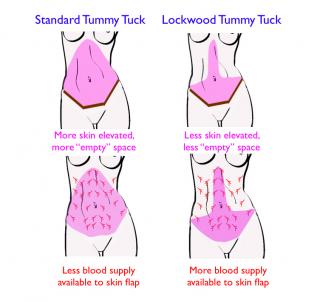
The differences between the Lockwood Tummy tuck technique and the standard Tummy tuck technique are illustrated in this diagram on the left.
The pink area represents the amount of dissection which is done in each technique. The Standard technique is shown on the left hand side, the Lockwood technique on the right hand side.
You can see that the Lockwood technique has much less dissection of the tissue. This is a good thing. Notice that the Lockwood technique lifts only the skin along a central tunnel in the middle of the abdomen. The sides stay attached.
The Lockwood technique has the following positive influences on the surgical outcome:
Less tension at the surface, and more tension at the deeper layer
The surface of the horizontal scar will not spread if it is more tightly closed in the deeper layers. When suturing the wound closed, the Lockwood technique puts the most tension on the Scarpa’s fascia, which is the deeper layer of the tissue. When the deepr layer is closed with more tension, the skin at the surface can be closed with minimal tension. This type of closure will prevent the scar from getting wider. In addition since there is little tension at the surface of the scar, there is less tendency for the scar to ride up as tissue relax. In summary the scar stays below the bikini line.
Better blood supply with the Lockwood technique means faster healing
By having less dissection of the tissues with the Lockwood technique , the skin flap preserves most of the blood supply, With more blood supply, the healing is better, faster and with less scarring. Better blood supply with the Lockwood means faster healing. With less tension at the surface of the scar, there is less tendency for the scar to rise up above the bikini line.
Lockwood technique has few seromas and hematomas
As if this were not enough, the Lockwood technique also has fewer complications than the traditional method. Less complications allows for a better healing incision. I use the Lockwood technique for all of my Tummy tuck and Body lift procedures. I have written about the use of the Lockwood technique in the Body lift procedure previously. You don’t need to have a thick scar following your Tummy tuck.
Can the Tummy tuck scar be hidden way below my panty line?
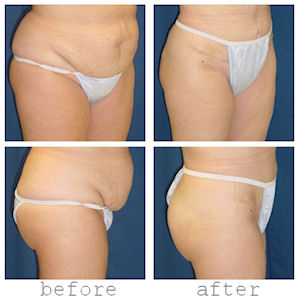
This patient’s set of photos, before and after her Abdominoplasty, provides a good example of how a tummy tuck can help repair a separated rectus abdominis muscle, tighten the stomach area, and get rid of loose or wrinkled skin
…without having to deal with an unsightly scar.
Please view my gallery of Before & after Tummy tucks to see that my patients do not have thick scars!


Judith L Jimenez says:
Dr. Ricardo L Rodriguez says:
christina rager says:
Dr. Ricardo L Rodriguez says:
Sue says:
Dr. Ricardo L Rodriguez says:
Zan Lapps says:
Dr. Ricardo L Rodriguez says:
Lucia Crisp says:
Dr. Ricardo L Rodriguez says: