


I have been looking at Tummy tuck forums, just to get an idea of how patients perceive the whole experience of surgery of the abdomen, or Abdominoplasty. Two things struck me.
The first one was the large number of patients who complain of swelling, both immediately after surgery, and weeks after.
The second is that a lot of patients are still getting fluid collections that have to be drained with a needle, sometimes repeatedly.
I think a lot has to do with the type of technique the plastic surgeon uses for the Tummy tuck procedure. In my opinion, the Lockwood technique offers superior results for my tummy tuck patients.
I think postoperative Tummy tuck swelling and seromas (fluid pockets) are largely preventable by:
- The surgeon’s choice of abdominoplasty technique
- Post-operative compression
In today’s post I would like to discuss the three types of techniques used in the Abdominoplasty procedure. Surgical technique influences blood supply disruption and post-operative swelling, so let’s take a look a closer look.
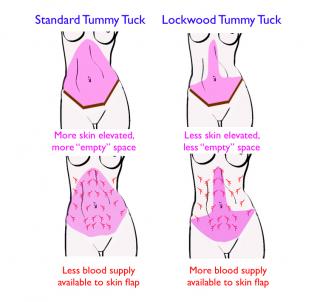
The standard Abdominoplasty techniques and the Lockwood techniques are illustrated in the diagram here. They are the two most common types of Tummy tuck techniques used. The pink sections of the diagram shows the amount of tissue that is dissected or elevated for the procedure.
Standard abdominoplasty technique
The standard abdominoplasty surgical technique (or standard tummy tuck) is taught in most plastic surgery residency programs. Therefore, this is the procedure that most plastic surgeons perform. This technique gets the job accomplished, but the large area of dissection does disrupt the blood supply, which can lead to fluid build up and seromas.
The diagram above illustrates how the standard abdominoplasty operation lifts the abdominal skin from the pubis all the way to the rib margins, the excess skin is cut (usually at the level of the belly button) and the remaining upper abdominal skin is stretched down to the level of the pubic mound.
Since such a large area of skin is being dissected, this results in a large area with blood supply disruption. The area with blood supply disruption is represented on the left by the pink shaded area WITH red x’s. You can see that a large area does have blood blow disruption. The problem with the standard technique is that it cuts off the blood supply coming up from the muscles to the abdominal skin.
Secondly, the space that was created by the separation of skin flap from muscle is now an empty space where fluid can build up. This is why drains are so important with this technique – they suck the fluid out as it builds up, allowing the skin and muscle layers to stick together again.
Lockwood abdominoplasty technique
The Lockwood abdominoplasty surgical technique (or Lockwood tummy tuck) separates much less tissue and is less disruptive to blood supply. From the belly button to the breast bone it only separates a narrow tunnel. This leaves most of the abdominal skin tethered to the muscle and its blood supply. Thus, you have more blood supply in the general area, which is a good thing. The area with blood flow disruption is much smaller in the Lockwood technique compared to the Standard technique.
The fact that the skin stays tethered means there is less chance for fluid accumulations. The fact that the skin has better blood supply has a lot of positive implications. For example, I can liposuction a lot more before worrying about interfering with blood supply. And the wound itself heals better because of the better blood flow. Similarly, if there are other existing scars in the abdomen, such as an old gallbladder scar, this technique is less likely to interrupt the blood supply. And finally, the increased blood flow allows for more compression so that I can tighten the area better (without fear of interfering with blood flow). Thus, I get a much better aesthetic result in my Tummy tucks by using the Lockwood surgical technique.
The Lockwood technique is a great option for preventing fluid accumulations (seromas), like the Pascal technique, but it accomplishes so much more because of the improved blood supply to the skin flap.
Use AI to summarize:
The Lockwood technique places much of the wound tightening on a deep layer of tissue called Scarpa’s fascia. Other techniques, such as the standard technique, use more tension near the incision area which can result in thick scarring. Since the wound tightness is diverted away from the skin with the Lockwood technique, there is less chance of thick scarring. Likewise, since the Scarpa’s fascia is better anchored to the deeper tissues, there is less chance of the scar settling upwards towards the belly button.
In the early years of my practice I used the standard abdominoplasty technique and patients would sometimes get thicker scarring postoperatively, which would necessitate steroid injections and crèmes to reduce the scars. Now that I use only the Lockwood technique, I see patients at 4 months for photographs and I never get requests for scar fading creams.
Pascal, or drainless Tummy tuck technique
There is another technique called the Pascal, or Drainless Tummy tuck technique where the abdominal skin flap is sutured in quilt like fashion to the abdominal wall to prevent accumulations pockets. While it may be effective in preventing fluid accumulations, it does nothing to improve the blood supply of the abdominal flap, which I feel is so important for the reasons listed above. Thus, I do not use this technique.
My favorite Tummy tuck technique is the Lockwood technique
The Lockwood technique is a great option for preventing fluid accumulations (seromas), like the Pascal technique, but it accomplishes so much more because of the improved blood supply to the skin flap.


Jamie says:
Jamie says:
Dr. Ricardo L Rodriguez says:
Jodie Narayan says:
Dr. Ricardo L Rodriguez says:
JAMIE says:
Dr. Ricardo L Rodriguez says:
Twanna Washington says:
Dr. Ricardo L Rodriguez says:
Sheila says:
Dr. Ricardo L Rodriguez says:
maria says:
Dr. Ricardo L Rodriguez says:
Adia says:
Dr. Ricardo L Rodriguez says:
cream says:
Dr. Ricardo L Rodriguez says:
Sandy says:
Dr. Ricardo L Rodriguez says:
cream says:
Dr. Ricardo L Rodriguez says:
Robyn says:
Dr. Ricardo L Rodriguez says:
Lanette says:
Dr. Ricardo L Rodriguez says: